
About CoreGamers
From a notebook sketch to an obscure Portuguese-English website

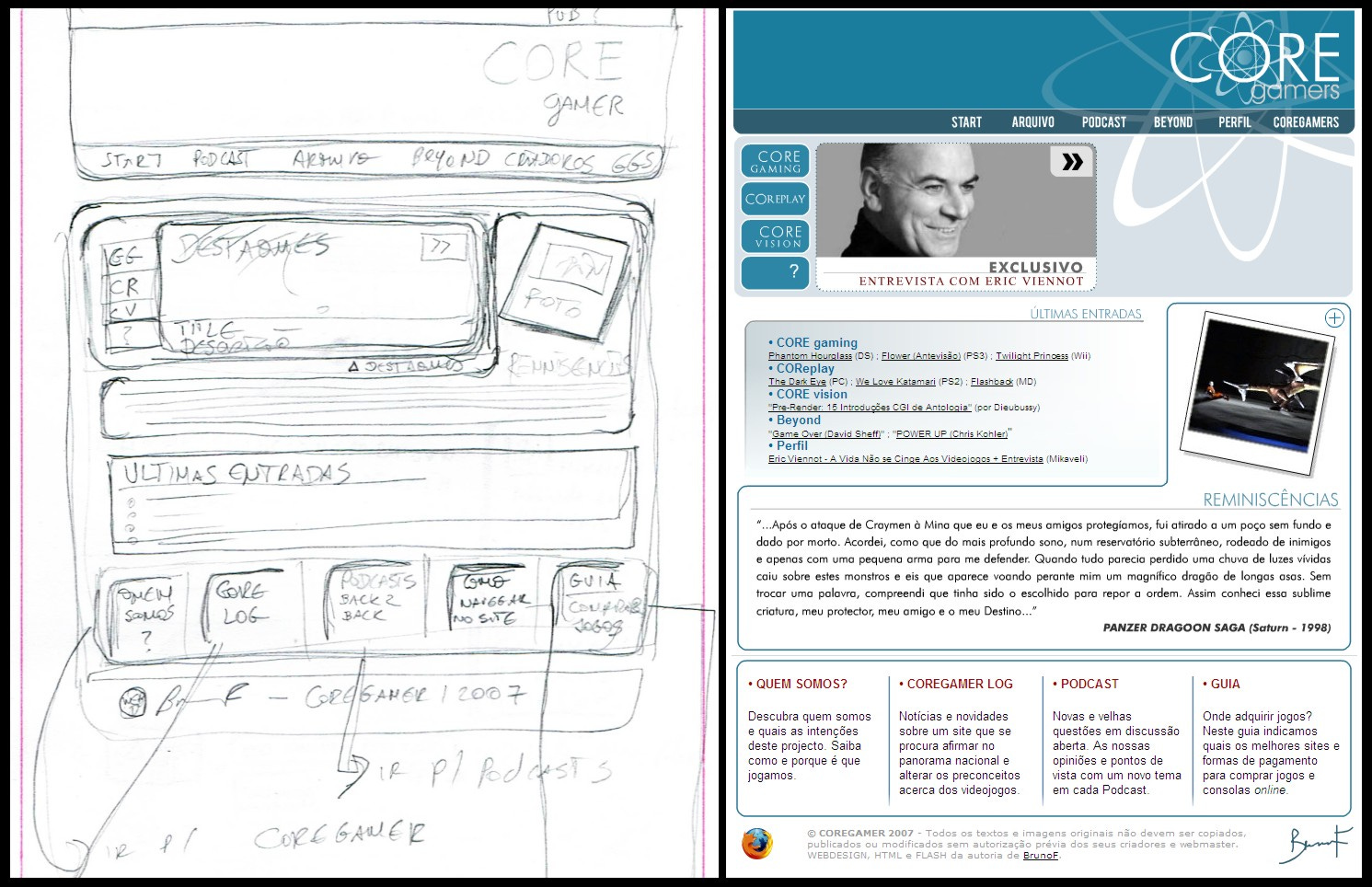
In 2006 I was a clerk at a local video games shop. During my time there I had the opportunity to meet many interesting locals who shared an interest not only for games but for cinema, comic books and japanophilia in general. Part of the pleasure of these exchanges came from becoming acquainted with enthusiasts who were more well-versed than I in a handful of specific topics, making this day job also about learning and networking. One visitor in particular, a law student, seemed to share some of my concerns about how the games industry, after a golden era of some fifteen years, was displaying its first signs of rapid decay.
In one of our long talks into the night, as I closed the shop and we walked home, we agreed that it would be interesting to create a website celebrating what we believed to be the proper tradition of video games, with an emphasis on authors and their works, not on companies or hardware specifications. As time went on and our friendship developed, Mickaël and I started jotting down some more specific ideas of how the site would be structured, and how to make it look functional yet different from the popular gaming pages of the day. The name itself was the most challenging aspect. In the end we agreed with CoreGamers, a play on the common denomination hardcore gamer, as we felt that embodied our mission statement.
Having dabbled in web design for some years, I used my meager knowledge of HTML and Flash to put together the final version, having discarded a prototype or two in the process. We agreed from the very start that the page would not host any publicity, and that we would invest in it only what time we could spare. The page was uploaded to a free hosting Portuguese website, Simplesnet, and never had a dot com domain. I called upon a few other friends to contribute with articles of their own so as to generate as much content as possible in a short amount of time. A new written publication that emerged in Portugal in 2007 was encouraging readers to submit their websites so they could be featured in the magazine. CoreGamers made it to one of their issues and the website traffic witnessed a sudden increase, having plateaued after a month or two. Our new strategy to increase traffic was to start translating new articles into foreign languages - English, primarily, but also French -, as well as to use whatever exclusive information we had in our features as references for Wikipedia submissions. I always felt this to be a questionable practice, if efficacious in connecting directly to the sort of audience whom the article could be of interest to.
Due to time constraints from the co-founder, by the end of 2007, I was forced to take over the entire post work activity of managing the page. At this stage I must admit that I had little or no experience as a writer. However, the few months of contributions to the page made me feel confident enough to aspire to other pursuits. Armed with my free Microsoft Hotmail account, I reached out to various names in the industry, starting with independent US game designers - at a time when the word indie was still not commonly used -, then moving to retired or inactive creators. By 2008 I was able to expand the range to a handful of European and Japanese game creators. Part of the success of these interview requests came from my ability to convey my utmost passion for their creations, and that I had researched the topics sufficiently to provoke a reaction. Over the years I found that the game designers I tended to make contact with had a marked preference for a more serious and rigorous approach.
But the creation of each article was an uphill battle of sorts, as I was never sufficiently agile with HTML and spent undesirable amounts of time ensuring images and text were formatted and displayed correctly, correcting meaningless errors in the code, or making manual corrections that needed to be replicated for every other article published. Ultimately, the convenience of blogging tools persuaded me to abandon the CoreGamers site and initiate a series of thematic pages at Blogspot.com, where I could concentrate entirely on content and spare myself the frustration of bug-ridden WYSIWYG web editing.
More recently, my friend Rui Craveirinha was kind enough to host the website at www.coregamers.info. But with the recent drop in support for Flash in all major web browsers, navigating its content became almost impossible. This Substack will be a repository of sorts for the dozens of articles I believe to be worth saving from the original site. My goal is to ensure the information is kept online in a format better suited for reading, devoid of any problematic .swf files and missing images. As Wikipedia pages still preserve their links to the original site, I believe this to be a far better alternative to the usage of that nevertheless glorious invention that is the Wayback Machine.