
There is more to life than video games
Profile and interview with Éric Viennot

N'Y A PAS QUE LES JEUX VIDÉO DANS LA VIE was an article originally published on Coregamers on February 8th, 2007. The text and interview were authored by Mickaël Pereira, translated and edited by Bruno de Figueiredo.

Part I
Profile
Éric Viennot is born on March 10th 1960 in Lyon, France. He is, without a doubt, one of the most talented French game designers, possibly even the most talented of all at present. And yet he was not predestined to be so. Having studied plastic arts, he dedicated himself to photography, painting and shooting movies during the 80s. He cooperated with the group Equipage 10 in different multimedia expos and had his work on display in France, Germany, Italy and Denmark. Later, he taught at the Sorbonne University in Paris for a period of five years. In 1990, he created the studio Lexis Numérique along with Marie Viennot, his sister, and José Sanchis, who would become his brother-in-law and business partner. A pioneer in the field of 3D images, since 1994 he spearheaded a number of multimedia projects in the role of graphic designer and artistic director.
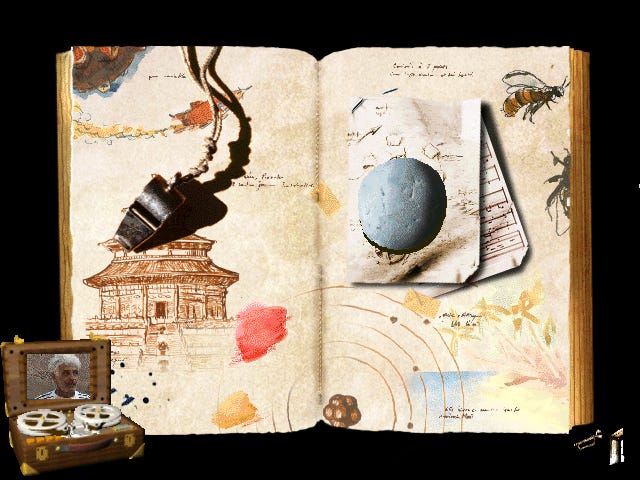
In 1998, he created L’ALBUM SECRET DE L’ONCLE ERNEST, the first episode in a series of adventure games directed at children, which received several international awards. Two years later, it was also adapted into a children’s book format. Halfway between a point and click adventure game and educational software, it would be followed by four additional episodes: LE FABULEUX VOYAGE in 1999, L’ILE MYSTÉRIEUSE in 2000, LE TEMPLE PERDU in 2003 and LA STATUETTE MAUDITE in 2004. The series narrates the daring adventures of uncle Ernest through a live, interactive album. The experience itself is filled with poetry and nostalgia for its intended infantile audience, having also captivated the attention of many an adult. It was met with immense success, such that it was translated into fifteen languages.
In 2002, Viennot gives birth to a new series, LA BOITE À BIDULES DE L’ONCLE ERNEST, a spin-off of the previous games, designed for an even younger audience - L’ONCLE ERNEST was created specifically for ages between eight and twelve. This four episode game narrates the adventures of four vintage toys that live in an attic.

In 2003, Viennot’s talents are further affirmed. Lexis Numérique revolutionizes the then stale adventure game genre with his IN MEMORIAM (MISSING in the US). Responsible for both the concept and direction, this game was the first interactive thriller to converge video games, cinema and internet. Jack Lorski, a reporter, and his friend Karen Gijman have disappeared. Subsequently, Jack’s agency recevies a mysterious CD-ROM, created and mailed by a serial killer under the moniker Phoenix, in which all the necessary clues to find them. The task, however, is far from straightforward: to decipher the information one needs to solve a multitude of enigmas requiring insight and shrewdness. To increase the chances of retrieving their missing friends, the agency makes a decision to make the CD-ROM content publicly available, accounting for the reason why players find themselves in its possession. One unique aspect about the game is that the player navigates it not as a virtual character but as themselves; the riddles contained in the game having to be resolved in real life.
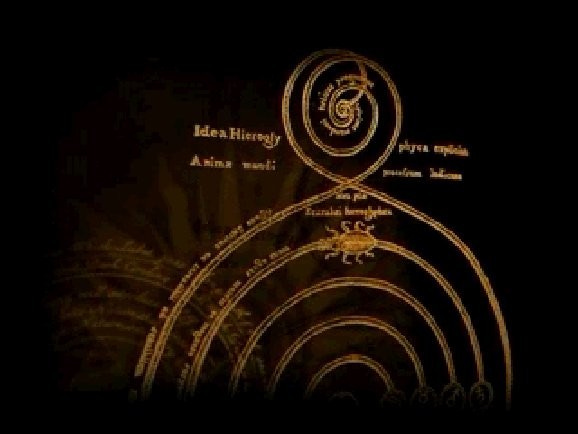
On occasion, the serial killer provides hints: some helpful, others false leads meant to distract from the task at hand. Additionally, the player is free to consult a database containing texts and videos. More uniquely, the player is asked to expand this research to the world wide web, for which purpose Lexis created an assortment of websites and web forums. Surprisingly, even a handful of real websites agreed to post news and information about the disappearance, with search engines producing valuable results for searches beginning with character names or other key words. Other pieces of information reach the player directly via email and, exclusively in France, players could even receive text messages and phone calls, lending the intrigue further credibility and sense of involvement.
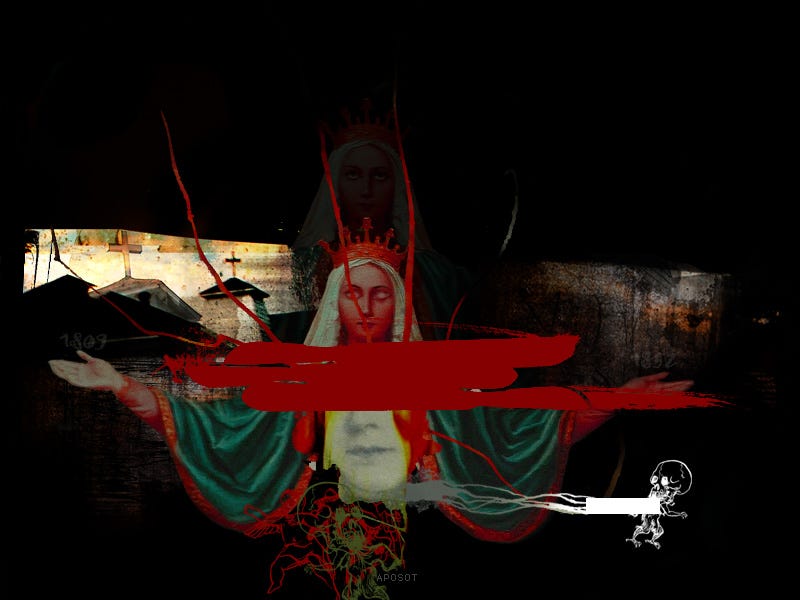
The degree of immersion offered by this game was altogether unseen, the line between reality and fiction never so blurred before in a video game, an irrecusable argument for video game realism as a function of the relationship between the player and the game, as opposed to photorealistic graphics. Viennot’s game had minimalist visuals, perfect in their form and function, setting a somber tone that is fitted to the theme - worthy of the best Hollywood film thrillers. Video sequences are equally of a high quality, with convincing performances that further reinforce its verisimilitude.
In 2004, the studio releases an add-on named LA TEIZIEME VICTIME and, in 2006, the sequel LE DERNIER RITUEL. All at once, Viennot is working in other productions directed at children, namely LES AVENTURES DU POISSION ARC-EN-CIEL, LA BELLE ET LA BÊTE, E.T. L’EXTRATERRESTRE, and LE LIVRE DE LA JUNGLE; working as an artistic director in ludoeducative and didactive for publishes such as Hachette, Nathan, Armand Colin, TLC Edusoft, Emme Interactive and BMG Interactive; and supervising television shows such as ALEXANDRA LEDERMAN and C’EST PAS SORCIER.
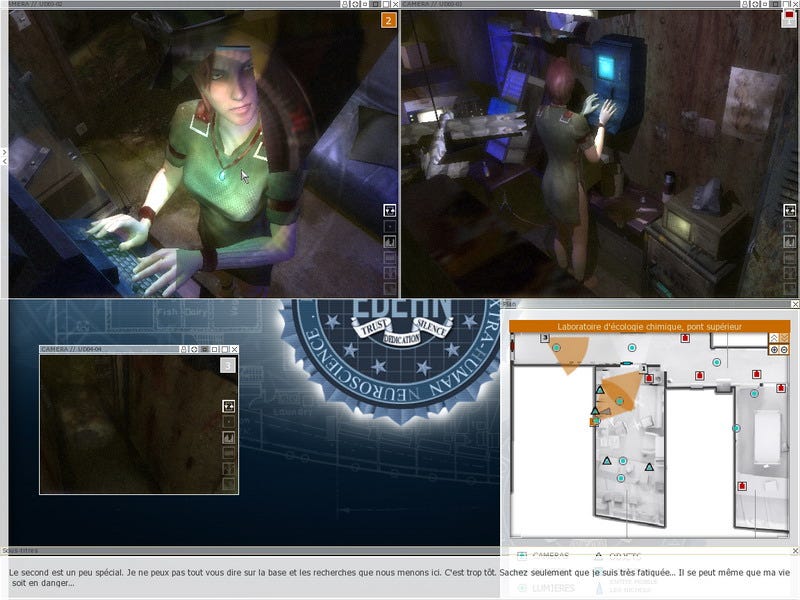
Lexis’ last game, EXPERIENCE 112, is an original concept from Nicolas Delaye that also counted with the participation of Viennot as a scriptwriter. A highly enveloping adventure, it originally suggests a game design where the player does have direct control of the protagonist, Léa Nichols. The player assumes the role of another character with partial access to a security system composed of closed circuit surveillance, electronic doors and lighting. A combination of the above can be used to instruct and guide the on-screen character with her progression. As a result, the game proposes an unusual scheme where there is a character that is visible and known, but that cannot be controlled; and a character controlled by the player about which nothing is known.
In March 2007 he was the recipient of the honorary title Chevaliers des Arts et des Lettres, by the hands of the prime-minister François Fillon, a recognition reserved to those whose works consist of meaningful advancements of French culture.
For Éric Viennot, videogames are a radically different form of media that make storytelling possible in a newfound way. His interest lies primarily with interactive fiction because he believes that video games, a century after the birth of cinema, permit unique explorations in the form of narratives, capable of conveying singular emotions. Currently, he devotes his time to the creation of new projects for the Wii, DS and Windows PC, at the same time writing a new genre of interactive TV fiction blending different media such as the Internet, blogs, mobile phones, printed press and interactive games. A model of total function which IN MEMORIAM introduced, but that will extend into unseen permutations of this desire to conjoin reality and fiction in a space where both become indistinguishable from one another.
Part II
Interview
COREGAMING : Your background in the plastic arts scene of the ‘80s and your teaching position at one of Paris’ most prestigious university are in stark contrast with your current occupation as a game designer. What was for you the declic? Was there any particular game or simply the evolution of games as a medium?
ERIC VIENNOT : It was gradual. I first became interested with digital imagery, and then with 3D. Having been educated as a plastic artist, for me these represented a new form of visual expression, an open field with many possibilities. Progressively, I took on the role of artistic director. At the start of the 1990s I had connections with various multimedia editors for whom I created packaging, different communication supports, before I occupied myself with building the interface of a few of their productions. I soon realized that we could create animated universes and even stories thanks to this new form of media. The aspiration to tell stories is the premise behind my first creation, L’ALBUM SECRET DE L’ONCLE ERNEST, an adventure game designed for children. For this game I took more inspiration from movies - MON ONCLE by Jacques Tati, L’HOMME DE RIO by Broca, RAIDES OF THE LOST ART, etc. - as well as literary universes - Jules Verne, Hergé and Stevenson - than I did from video games. I only became a player much later in my life when me and my child, currently eleven years old, started sharing a gamepad.
CG : Was Lexis Numérique founded with the purpose of creating videogames? Your first videoludic project was only released in 1998, a full eight years after the studio was established. Meanwhile, you collaborated in numerous multimedia projects - was that not the principal aim of the studio, at first?
EV : There was something that was determining in the creation of Lexis Numérique: my encounter with José Sanchis, later my brother-in-law and partner. An engineer by training, he had always had an entrepreneurial spirit and lead me to set up the studio with him. We split the tasks, he was in charge of the commercial side of operations, I was content creator and producer. At first we were in effect a studio specializing in the creation of digital images, hence the name lexis, a word referring to the entirety of words in a given vocabulary; and numérique, the French word for digital. Afterwards, as José Sanchis was trained as a coder, we started offering computer programming as a service. The objective was to create a multimedia project in its entirety without the need for outsourcing. In the mid ‘90s, multimedia became a cultural phenomenon, and that allowed us to join in the production. Yet I was quickly drawn to the video game universe which, due to its concerns with formal experimentation and narration, basically led me to believe they were the future of entertainment.
CG : L’ALBUM SECRET, a point and click adventure for MAC and PC clearly oriented towards a younger audience, was not perceived by critics as a game proper, instead some vulgar form of software, which to me feels like the worst possible insult one can direct at video games. Do you believe this relates to the fact that it’s directed at infants? How would you qualify it yourself? A game or a software program?
EV : This question pleases me immensely because to me, in truth, L’ALBUM SECRET DE L’ONCLE ERNEST is a true game. A small one at that - only five to six hours are required to see it through - but a real game, very different from the average educational software of the time. It was developed in object programming, containing the same principles that we find in many games - non linerarity, multiple solutions, animal AI, etc. I see it as an adventure game. It was able to bring children and parents together around the computer, well before the current trend of casual gaming.
CG : You only obtained recognition as a game designer after creating IN MEMORIAM. Do you agree that it is deplorable that creations destined to a younger audience are prone to being considered as lesser, even though they have a capital importance in the development of an individual’s personality?
EV : Exactly, but that is also true in other domains in which productions directed at younger audiences are erroneously considered as inferior. We nevertheless find true masterpieces: ADVENTURES OF HUCKLEBERRY FINN is a fine example of this in literature; as are some of the films by Pixar for cinema. For me, L’ONCLE ERNEST is as important as IN MEMORIAM and I too find it deplorable that you need to create contents for adults to merit any form of respect and to be considered a true author.
CG : IN MEMORIAM is without a doubt one of the boldest and original games of all time, none should be afraid to say. But in spite of the positive sales and excellent critical reception, do you not think that the game deserved an even better recognition? Are you of the opinion that the game suffered due to it being French? We can denote a parallel with cinema, where American films obfuscate the rest of the world’s. Would you also say that Japanese videogames are having a similar effect relative to European productions? I am tempted to add that the game received more coverage in the generalist press than in specialized game outlets.
EV : It is true that we have received more coverage by the generalist press and television than most games have until this day. However, we were also well received by the specialized press. But many journalists told me “I will play the game but our readers prefer simpler games”. The good surprise is that the game was a success in the United States. I think that this is often a marketing problem. In Europe, the game was perhaps overly announced as an author game. In the US, the publisher presented it as a thriller for the a mass audience. Maybe this is the reason why it worked better over there. So yes, many times, a game depends entirely on how it’s marketed. Without any marketing, it will be hard for a game to find its audience. I can become a cult success with enough hype but it will hardly ever become a commercial success. That’s a shame. New channels for information dissemination - namely the Internet - may alter this landscape entirely.
CG : Although their universes are almost the opposite of one another, your works have a common essence, especially L’ALBUM and IN MEMORIAM. How do you account for that? Can we speak of a Viennot touch?
EV : I believe that it is due to the fact that they are somewhat artisanal productions. It’s easier for an author to imprint his touch in a production involving no more than a dozen people - in total we had more than a dozen for IN MEMORIAM but the core team was composed of only ten collaborators - than in a larger scale production.
Without a doubt, my history as a designer and artistic director heavily influenced my creations. I write the script for my games, I create a part of the game design, and I take over the artistic direction. It is for that reason that my creations have common aspects even though they approach different themes. Equally, I try to have people discover things that are of interest to them through my games, that are rarely found in a game. Beyond simple fun, I visualize my games as potentially enriching for the player.
CG : Curiously, the universe of the L’ONCLE ERNEST series reminds me of the creations of Jean-Pierre Jeunet and the music themes have something of Yann Tiersen in them, but I cannot explain why. What would you say are your main artistic influences?
EV : It’s not the first time that I hear this. It’s true that the universe of the game is very close to those of Jeunet, perhaps because we more or less belong to the same generation. I wish to highlight that the musical themes in L’ONCLE ERNEST, composed by Jean-Pascal Vielfaure, precede those of Tiersen for AMÉLIE POULAIN. My film influences are diverse. I particularly enjoy the independent cinema of Coppola, Jarmush, Wayne Want, Eastwood, Lynch, James Gray or older ones like Nicholas Ray. I have a similar appreciation for the Asian cinema of Ozu, Kitano or Wong Kar-Wai. In literature, I am a fan of detective novels, from the great classics like those of Hammet, to the more contemporary ones from Elroy, Connely or Dantec. I am also a great follower of American TV shows. My favorites at the moment are SIX FEET UNDER, 24 and LOST.
CG : There is a large quantity of creators, studios and publishers from the city of Lyon such as Arkane Studios, Ludoïd, Infogrames (now Atari), Eden Studios. Among others, Frédérick Raynal is also from there. As you are also from the same provenance, do you believe there is a Lyon school of game creation?
EV : I was borne near Lyon but I spend my time between Marseille and Paris. If there is a Lyon school, I am not sure that I am a part of it, despite having nothing but sympathy for Raynal.
CG : You have always developed games for personal computers. However, you recently mentioned in your blog that you were teaming up with Paul Cuisset, the famous creator of FLASHBACK, for the creation of several projects for the Nintendo Wii. I am not looking for exclusive information on those games, only to know what attracted you about that system? Could this be because of the lower development costs? Would there be any particular reason why haven’t you tried to develop console games before?
EV : There are economical reasons, of course. Developing for a home console was for a long time well outside of our reach. Like many small independent studios, the personal computer became our platform of choice. The DS and the Wii inverted that trend. They are more accessible consoles because the budgets necessary for game production are considerably smaller. Regardless of financial problems, what interests me about Nintendo’s policy is its outreach to a greater audience. The games that I have created are not dedicated to hardcore gamers. I always thought that games would evolve by moving towards new audiences, namely adults, but also women. If one day I have the chance to develop a game for another platform, that would greatly satisfy me. But I have always considered video games a new medium that can renew the ancient art of telling stories by getting more involvement from people, independently of the platform that they are being played on.
CG : When do you intend to reveal the aforementioned games?
EV : I have developed a game with Paul Cuisset for the DS which should be released in a few months. More news are coming soon. We also have other projects for the Wii and the DS in production. We shall say more about them in 2008. I am personally related to two of those projects, one a children’s game for the Wii and the other a multi-platform title of some ambition, currently in pre-production.
CG : Will these games be made available via the traditional distribution methods or are you considering the use of Wii’s digital download platform WiiWare - still unavailable today - as an option?
EV : I cannot comment at this stage but both the Live Arcade and the WiiWare are in effect interesting alternatives for producers such as Lexis Numérique.
CG : What is your opinion of the other two systems presently available, the XBOX 360 and the Playstation 3?
EV : The Playstation 3 interests me quite a bit because it is a more family-oriented console than the XBOX 360. I believe that it’s a fabulous system that suffers from a poor public image due to Sony’s disastrous commercial policy. The PS3 deserves better.
CG : Is there anything that you can reveal to us about you TV fiction project, one bringing different forms of media together? It sounds extremely interesting.
EV : That project is, evidently, the logic step forward after IN MEMORIAM. The conclusion I have arrived at with that game was that this type of project has much more of an affinity with television shows than it has with the video game universe, the latter being often very conservative. I am currently working on a project involving multiple television shows with an interactive dimension through a diversity of media. Right now I am in the process of completing the script. Looking at the ambition of the project and its cost, I am not entirely certain that it will even come to life. We never know. Television fiction needs to renew itself in order to attract the growing number of viewers who are opting out of it to take advantage from other forms of media like the Internet and games.
CG : You remain close to your public, which I find to be admirable. Is this due to your nature as a person or merely to keep an eye out for public preferences?
EV : It is a natural consequence of my line of business. I believe that artists cannot continue to inhabit their ivory tower was possible during the 19th century. That is a romantic conception of the artist that seems out of whack with the times we live in. An artist needs to communicate his work to convince, to share convictions. I estimate that this is a part of my job. It is a natural consequence. The artist must also remain attentive of the public. But nevertheless ponder. To try and please all parties is to renounce those convictions. A game designer requires strong principles to be able to impart a sense of vision. At the same time, a designer needs to be sufficiently humble to place him or herself in the position of the player, anticipate their reactions and emotions. It is a hard balance to achieve.
CG : How close are you to the other great names of French game design such as Benoît Sokal, Michel Ancel, Eric Chahi, Paul Cuisset, Frédérick Raynal or David Cage?
EV : I find myself in the company of all of the above from time to time, some more than others. Paul Cuisset has become a friend of mine, we have been working together for two years. But I have ample admiration for all the creators that you have cited, each for a different reason.
CG : What, in your opinion, is the future of media? Generally speaking, game players have something of a pessimist outlook. What about you?
EV : Players tend to be pessimistic because many of them lived strong videoludic emotions in the past, and those are connected to their infancies. They have a tendency to sacralize the past. Contrary to what many of those pessimistic spirits say, I am of the belief that we are only getting started. The golden age is yet to come. But I cannot tell if we will need to way another ten or twenty years.
CG : Before we end, any particular message you’d like to leave to our readers (in Portugal)?
EV : I like Portugal a lot, especially the city of Lisbon and its surroundings, where we filmed various sequences for IN MEMORIAM 2. I hope you will appreciate the interview and, if that is the case, I invite you to visit my blog regularly.